
Why Dermatologists Recommend Peptide Serums for Aging Skin
Collagen doesn't disappear overnight. It leaves gradually — a little each year, starting as early as your mid-twenties. By the time fine lines and sagging become visible, the skin has already lost a meaningful amount of its structural foundation. That's the challenge dermatologists are working against when they formulate anti-aging protocols for their patients.
Peptide serums have emerged as one of the most scientifically supported tools for addressing this decline. Unlike ingredients that merely mask the appearance of aging, bioactive peptides communicate directly with skin cells — signaling them to rebuild what time has worn away. The result is firmer, smoother, more resilient skin that improves with continued use, not just for a few hours after application.
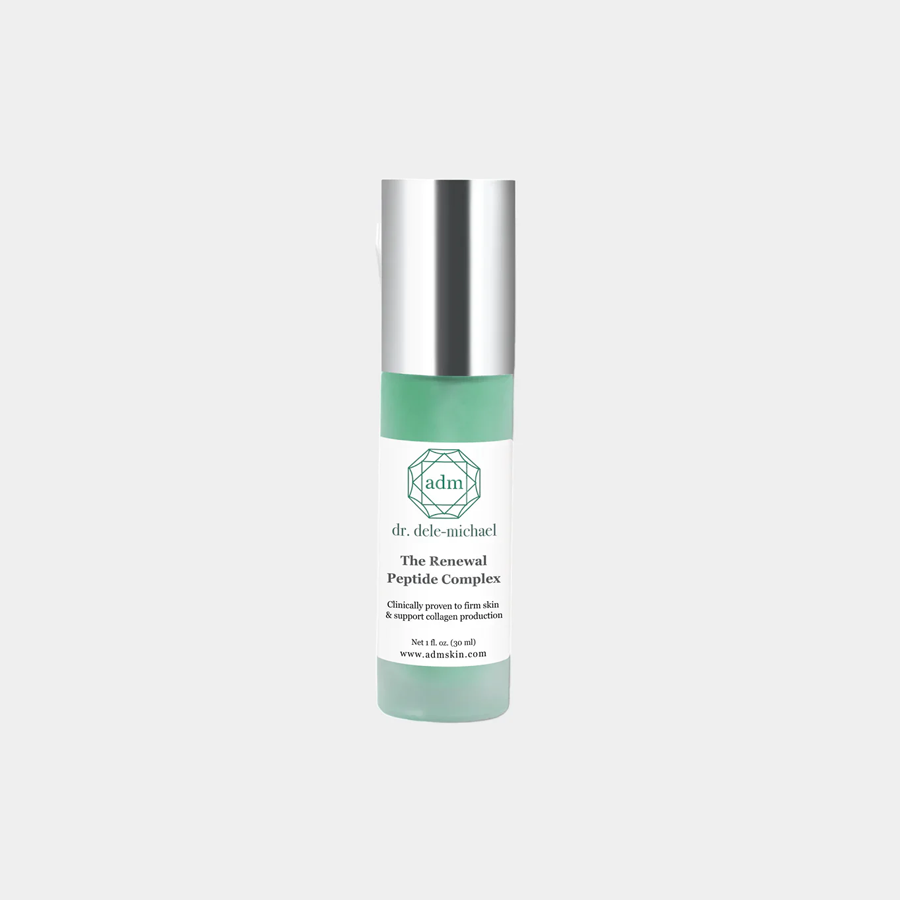
At ADM Skin, board-certified dermatologist and skin of color expert Dr. Dele-Michael has built her clinical skincare line around this science. Her formulations are designed to deliver real results across all skin types, backed by the same depth of expertise she applies in her New York practice at 116 Central Park South. The Renewal Peptide Complex ($135) is the cornerstone of that approach — a clinically proven anti-aging serum built on a validated peptide system and rated 4.9/5 by verified customers.
This post explains exactly why dermatologists recommend peptide serums, what the science says, and what to look for in a formula that will actually work.
What Happens to Skin at the Cellular Level as It Ages?
Aging skin is less a cosmetic issue than a biological one. Two proteins — collagen and elastin — are responsible for the skin's structural integrity. Collagen provides density and firmness; elastin allows the skin to snap back after movement. Together, they keep the complexion looking lifted, smooth, and youthful.
Fibroblasts are the skin cells responsible for producing both proteins. As we age, fibroblast activity naturally slows, collagen synthesis declines, and the skin's structural matrix weakens. According to research published in Frontiers in Medicine (2024), this decline in fibroblast-driven collagen production is a primary driver of visible skin aging — including fine lines, wrinkles, and loss of elasticity.
What Are Peptides, and How Do They Work on Aging Skin?
Peptides are short chains of amino acids — the building blocks of protein. When applied topically, certain peptides function as biological messengers, signaling the skin to ramp up its own collagen and elastin production. According to Optima Dermatology, peptides in skincare "are designed to send signals to the skin that encourage collagen and elastin production," directly countering the age-related slowdown in fibroblast activity.
Research published in the National Library of Medicine identifies peptides as "promising active ingredients with unique anti-aging properties," with studies demonstrating their efficacy in products designed to improve visible signs of aging.
Three categories of peptides are most relevant to anti-aging skincare:
- Signal peptides — Trigger fibroblasts to produce collagen and elastin
- Carrier peptides — Deliver trace elements like copper to support wound healing
- Neurotransmitter-inhibiting peptides — Reduce expression lines by relaxing facial muscles
Why Do Dermatologists Recommend Serums Over Other Peptide Formats?
The format matters as much as the ingredient. Peptides are most effective in leave-on products — serums and creams — where they have extended contact time with the skin. Rinse-off products and basic moisturizers either don't allow adequate absorption or dilute the active concentration too much to drive meaningful results.
Serums offer several distinct advantages for peptide delivery:
- Higher active concentration — Greater density of bioactive ingredients than most moisturizers
- Lightweight molecular structure — Fast-absorbing formulas allow actives to penetrate beyond the surface
- Targeted delivery — Applied directly to areas of concern before moisturizer
According to Cleveland Clinic dermatologist Dr. Wilma Bergfeld, the effectiveness of peptide-containing products depends significantly on formulation quality: "It takes good scientists thoughtfully compounding products to get the most out of them." This is exactly why dermatologist-formulated serums built on clinical expertise rather than marketing trends consistently outperform generic alternatives.
What Ingredients Make a Peptide Serum Truly Effective?
A peptide serum is only as good as its full formulation. The most effective anti-aging serums pair bioactive peptides with complementary ingredients that amplify results, protect the skin barrier, and ensure the formula remains suitable for daily use across all skin types.
The following combination of actives defines what Dr. Dele-Michael built into The Renewal Peptide Complex:
The Renewal Peptide Complex: Dermatologist-Formulated for Measurable Results
The Renewal Peptide Complex was formulated by Dr. Dele-Michael to bring clinical-grade anti-aging science into a daily skincare routine. Clinically proven to firm skin, rebuild collagen, and visibly reduce the depth of fine lines and wrinkles, it functions as a daily rebuilding treatment — not just surface-level hydration.
- Clinically proven to firm skin and support collagen production
- Stimulates fibroblast activity for structural skin renewal
- Visible improvement in skin texture within 2 weeks
- Fragrance-free and paraben-free
- Suitable for all skin types, including sensitive and mature
- Rated 4.9/5 by 48 verified customers
How to Use a Peptide Serum for Best Anti-Aging Results
Getting the most from a peptide serum comes down to consistent application and smart layering. Here's how Dr. Dele-Michael recommends using The Renewal Peptide Complex:
How Does The Renewal Peptide Complex Compare to Other ADM Skin Serums?
ADM Skin's serum range is built around targeted concerns. Choosing the right serum — or combination of serums — depends on your primary skin goals:
- The Renewal Peptide Complex ($135) — Best for firming, structural renewal, and visible reduction of fine lines and wrinkles.
- TRIFECTA PEPTIDE CE + GTP SERUM ($133) — Peptide-vitamin C combination for aging and antioxidant protection.
- QUINFECTA RETINOL + BAKUCHIOL 5X ($133) — Retinol-based approach with bakuchiol for deeper wrinkle reduction.
Formulated by Dr. Dele-Michael · Board-certified dermatologist · Skin of color expert
Clinically proven · Visible improvement in 2 weeks
Frequently Asked Questions
What do peptides actually do for aging skin?
Peptides are short chains of amino acids that signal skin cells — specifically fibroblasts — to produce collagen and elastin. Because natural fibroblast activity slows with age, topical peptide serums help compensate for this decline, visibly improving skin firmness, smoothness, and elasticity with consistent use.
How long does it take to see results from a peptide serum?
Results vary depending on formulation quality and consistency of use. ADM Skin's The Renewal Peptide Complex is clinically proven to produce visible improvement in skin texture within 2 weeks. More significant firming and wrinkle reduction typically develops over 4–8 weeks of daily AM and PM application.
Are peptide serums safe for sensitive skin?
Yes. According to Optima Dermatology, peptides are "generally well-tolerated and non-irritating — even by individuals with sensitive skin." The Renewal Peptide Complex is specifically formulated to be fragrance-free and paraben-free, with calming botanicals included to reduce reactivity. It is safe for sensitive, mature, and post-procedure skin.
Can peptide serums replace retinol for anti-aging?
Peptide serums and retinol work through different mechanisms and are not direct substitutes. Retinol accelerates cell turnover; peptides stimulate collagen synthesis by signaling fibroblasts. For those who cannot tolerate retinol, a peptide serum like The Renewal Peptide Complex offers a clinically supported alternative. For those seeking both benefits, ADM Skin's QUINFECTA RETINOL + BAKUCHIOL 5X provides a complementary approach.
Why is a dermatologist-formulated peptide serum better than a generic one?
Formulation quality is the primary differentiator. As Cleveland Clinic's Dr. Wilma Bergfeld notes, "It takes good scientists thoughtfully compounding products to get the most out of" peptides. A dermatologist-formulated serum ensures that peptide concentration, delivery system, and complementary actives are optimized for clinical efficacy — not just label appeal.
Is The Renewal Peptide Complex suitable for skin of color?
Yes. Dr. Dele-Michael is a board-certified dermatologist and recognized skin of color expert. ADM Skin products are formulated with all skin tones in mind, and The Renewal Peptide Complex is suitable for all skin types — including those with hyperpigmentation concerns or post-inflammatory sensitivities common in deeper skin tones.
Leave a comment